
Climate Resilient Drainage Trends in London
A short, intense downpour can put more pressure on a drainage system than a full day of steady rain. That is why climate resilient drainage trends are moving beyond large-scale flood defences and into everyday decisions for London homes, commercial sites and construction projects. The priority is straightforward: understand how water moves around a property, keep drainage assets working at their designed capacity, and address weaknesses before they become disruption, damage or an emergency call-out.
For property managers and facilities teams, this is an operational issue. For homeowners, it is often a matter of protecting a property from foul water backups, surface water pooling and costly repairs. The right approach depends on the building, its drainage layout, surrounding ground levels and the condition of the existing system.
Why London drainage systems are under greater pressure
London has extensive hard surfacing, ageing drainage networks and dense development. When rain falls quickly, it cannot soak into paving, roofs, roads and compacted ground as it would on open land. It runs into gullies, channels and private drains, which can reach capacity quickly if they are poorly maintained, damaged or incorrectly connected.
Climate resilience does not mean assuming every drain can cope with every storm. It means reducing avoidable restrictions and planning realistically for periods of heavy rainfall. A blocked gully may seem minor in dry weather, but during a downpour it can direct water towards entrances, loading bays, basements or neighbouring land. Likewise, a drain with root ingress, displaced joints or a partial collapse may still pass some water until heavy flow exposes the fault.
For commercial premises, the consequences can include unsafe access, interrupted trading, damaged stock and hygiene concerns. On construction sites, standing water can delay works and affect safe movement. At domestic properties, repeated ponding can damage landscaping, paths and external finishes, while surcharge from the drainage system can lead to far more serious internal issues.
Climate resilient drainage trends shaping property decisions
The most useful trends are not always highly visible. They tend to involve better inspection, better maintenance and drainage designs that manage water closer to where it falls.
More planned inspection and preventative cleaning
Reactive drainage work will always be necessary, particularly after a sudden blockage or flood event. However, more property owners are moving towards planned maintenance because emergency work is often the result of a problem that has been developing for months.
Routine cleaning of gullies, channel drains, interceptors and pipework removes silt, leaves, grease and debris before they restrict flow. The right frequency is site-specific. A restaurant, warehouse yard or school with mature trees will have different risks from a typical residential street. Seasonal checks before autumn and ahead of forecast periods of heavy rain can be particularly worthwhile, but maintenance should be based on the assets on site rather than a fixed one-size-fits-all schedule.
CCTV drainage surveys becoming a planning tool
CCTV surveys are increasingly used before problems become urgent. A professional survey can identify structural defects, scale build-up, root intrusion, poor connections and areas where water or waste is repeatedly collecting. This gives an owner or manager evidence for prioritising repairs instead of repeatedly arranging clearance work at the same location.
For buyers, developers and contractors, a survey can also establish the condition of existing underground drainage before refurbishment, an extension or major groundworks begin. That matters where an older private drain may not be capable of handling additional roof area, new sanitary facilities or changed site levels.
A survey is not a substitute for cleaning where a drain is heavily blocked. In many cases, the pipework needs to be cleared first so the camera can produce a useful view. Used correctly, though, CCTV inspection turns assumptions into a clear maintenance or repair plan.
Sustainable drainage features where space allows
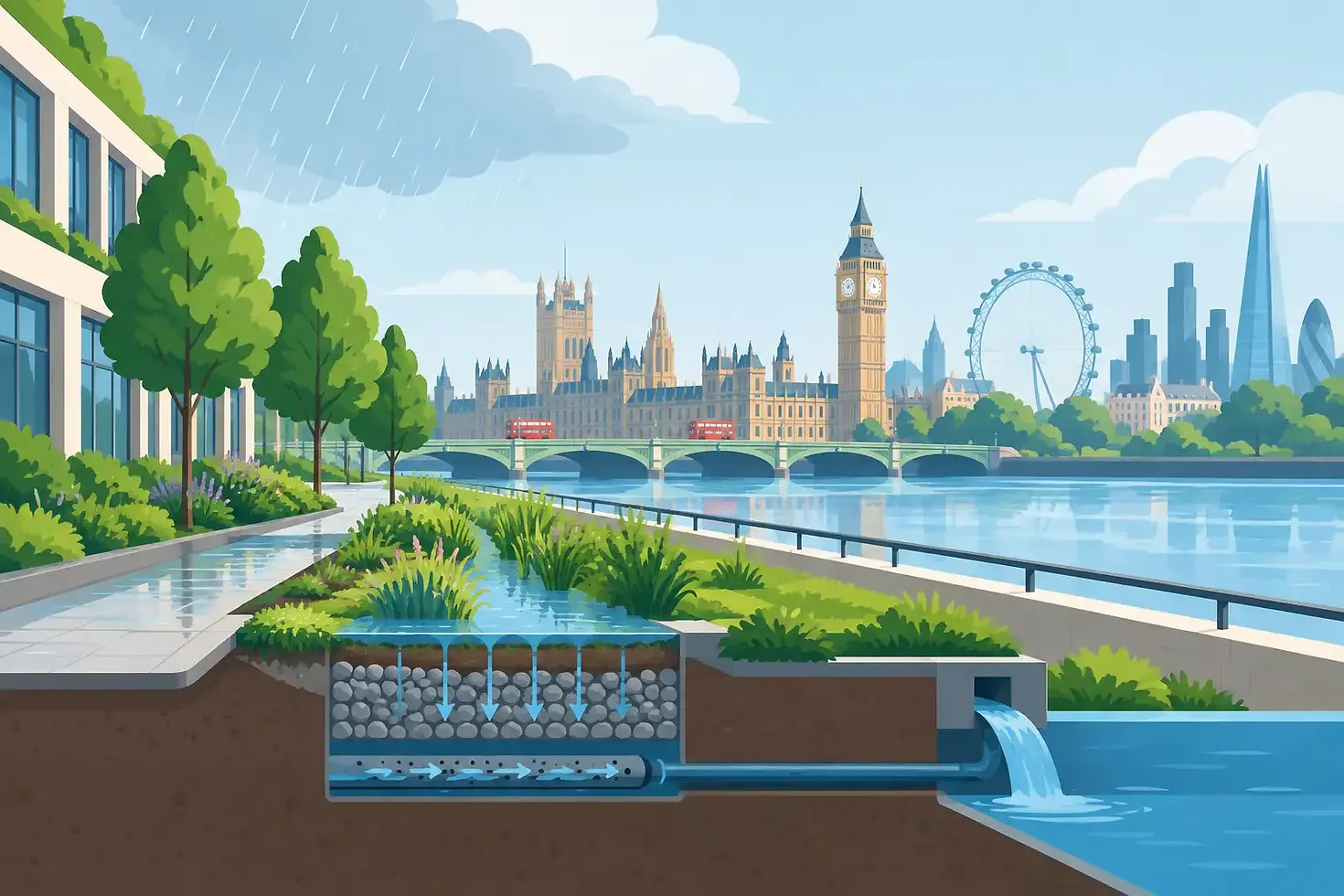
Sustainable drainage systems, often referred to as SuDS, are designed to slow, store, filter or allow rainfall to soak into the ground rather than sending it immediately into conventional pipework. On suitable sites, this may include permeable paving, rain gardens, swales, attenuation tanks, green roofs or soakaways.
These measures can reduce the peak flow leaving a property, but they are not automatic solutions. Soil conditions, groundwater levels, contamination risk, available space and local design requirements all need to be considered. A soakaway, for example, may be unsuitable in poorly draining ground or too close to a building. Permeable paving also needs regular attention, as sediment can reduce its ability to drain over time.
The practical lesson is that surface-water management should be considered alongside the existing drainage network. Installing a new feature without understanding falls, outlets and maintenance requirements can simply move the problem elsewhere.
Greater attention to roof drainage and gullies
Roofs are a major source of fast runoff, especially on commercial buildings, blocks of flats and extensions. Blocked gutters, defective downpipes and overwhelmed gullies are common causes of localised flooding, yet they can be overlooked because much of the system is out of sight.
Property teams are paying closer attention to roof outlets, leaf guards, downpipe connections and gully condition. The aim is not merely to keep water moving, but to ensure it is directed to the correct point without overflowing onto walls, walkways or lower-level areas. This is especially relevant after building alterations, when a downpipe may have been disconnected, redirected or left discharging onto unsuitable ground.
Data-led maintenance for larger portfolios
Larger estates, managing agents and facilities teams are increasingly recording drainage issues by location, frequency and cause. This creates a more useful picture than treating every blockage as an isolated event. If one gully repeatedly silts up, one stack regularly backs up, or one run of pipework needs jetting several times a year, there is usually a reason worth investigating.
Asset records, survey footage and maintenance reports can support budget planning and help teams decide whether cleaning, repair, relining or replacement offers the best long-term value. This approach is particularly useful for sites with multiple buildings, car parks, service yards or specialist waste systems.
What climate resilient drainage means in practice
Resilience starts with a clear distinction between surface water and foul drainage. Surface water comes from rainfall on roofs and hard surfaces. Foul drainage carries wastewater from toilets, sinks, kitchens and commercial processes. Cross-connections, damaged pipes and overloaded systems can create pollution and hygiene risks, so any suspected issue should be assessed by qualified drainage engineers.
It also means looking beyond the visible water. A flooded car park may be caused by blocked gullies, but it may also result from inadequate falls, damaged underground pipework, a collapsed connection or capacity limits further along the system. Clearing water away without finding the cause can leave a site exposed at the next heavy rainfall event.
For many properties, the sensible first steps are modest: keep gullies clear, avoid washing silt and debris into surface-water drains, arrange cleaning where build-up is known, and investigate recurring problems with a CCTV survey. These measures are generally more cost-effective than waiting for water to enter a building or disrupt operations.
When repair or upgrade is the better option
Maintenance cannot correct every defect. Cracked pipes, displaced joints, root ingress and local collapses will often require repair. Depending on access, pipe condition and the extent of the damage, options may include excavation, patch repair, relining or replacing a section of pipework.
The best option depends on the evidence. Relining can reduce disruption where a pipe is structurally suitable, while excavation may be necessary where the line has collapsed or levels need correcting. For sites being redeveloped, it may be more economical to combine drainage upgrades with planned external works rather than return later after a failure.
Burch Drainage Ltd supports Greater London properties with CCTV surveys, drain cleaning, repairs and planned maintenance, helping customers deal with immediate faults while identifying the work needed to reduce repeat disruption.
A practical priority for every property owner
The most effective response to heavier, less predictable rainfall is not to wait for a major flood before acting. Inspect the drainage system, maintain the parts that collect debris, investigate repeat issues and use survey findings to make proportionate repairs or improvements. A well-maintained system cannot remove every weather risk, but it gives water the best possible route away from the places where it causes the most damage.


Comments