

7 Best Drain Unblocking Methods That Work
- 2 days ago
- 6 min read
A blocked drain rarely starts as a major issue. It is usually a slow-draining sink, water backing up in the shower tray, a bad smell near a gully, or a toilet that suddenly will not clear. The best drain unblocking methods depend on what is blocked, where the blockage sits, and whether the problem is a one-off build-up or a sign of a wider drainage fault.
For homeowners, the right approach can save mess and avoid damage. For landlords, facilities teams and site managers, choosing the right method quickly matters even more because downtime, hygiene risks and disruption escalate fast. The key is not to throw random products at the problem. Some methods are safe and effective for light blockages. Others need professional equipment and trained engineers to clear the line properly without damaging pipework.
The best drain unblocking methods start with the type of blockage
Not every blockage behaves the same way. A bathroom basin usually blocks because of soap residue, toothpaste and hair. A kitchen sink tends to clog with grease, food waste and fat that has hardened inside the pipe. Outside drains can block with silt, leaves, wipes, scale, roots or collapsed sections of pipe.
That is why the first job is working out whether the blockage is localised or affecting a wider run. If one sink is slow but everything else is normal, the issue is probably close to that fixture. If several appliances are backing up, or if an external chamber is full, the blockage may be deeper in the system. The method needs to match that diagnosis.
1. Hot water and washing-up liquid for early grease build-up
This is one of the simplest options and often one of the most overlooked. In kitchen waste pipes, grease and fat can start to line the inside of the pipe long before a full blockage forms. A careful flush with hot water and washing-up liquid can sometimes shift minor residue and restore flow.
It works best when the sink is draining slowly rather than fully blocked. It is less useful on solid obstructions or where the pipe is already heavily restricted. Boiling water should also be used with care, especially on older plastic pipework, because excessive heat can do more harm than good. Warm to hot water is usually enough for a light build-up.
2. A plunger for sinks, basins and toilets
A proper plunger remains one of the best drain unblocking methods for straightforward domestic blockages. It creates pressure that can dislodge soft obstructions near the plughole or trap. Used correctly, it is quick, inexpensive and does not rely on chemicals.
The main limitation is reach. A plunger will not clear a blockage deep in the drain line, and it will not fix a pipe that has cracked, sagged or become obstructed by roots. It is also important to use the correct type. A sink plunger and a toilet plunger are not the same thing, and a poor seal often means poor results.
If plunging improves the flow briefly but the problem returns, that usually points to a partial blockage still sitting further down the line.
3. Cleaning the trap and waste pipe by hand
For basins and kitchen sinks, the blockage is often sitting in the trap. Hair, soap residue, food debris and grease collect there because it is the lowest point in the immediate waste pipe. Removing and cleaning the trap can solve the issue quickly if the blockage has not travelled further.
This method is practical for accessible pipework under sinks, but it is not always suitable in commercial environments or where waste lines are boxed in, awkwardly fitted or connected to more complex systems. It also needs care. If seals are not refitted properly, leaks become the next problem.
As a rule, if the blockage is clearly close to the fixture and access is easy, trap cleaning is reasonable. If the pipework is concealed, shared, or repeatedly blocking, it makes more sense to have the line assessed properly.
4. Drain rods for outside drains and deeper obstructions
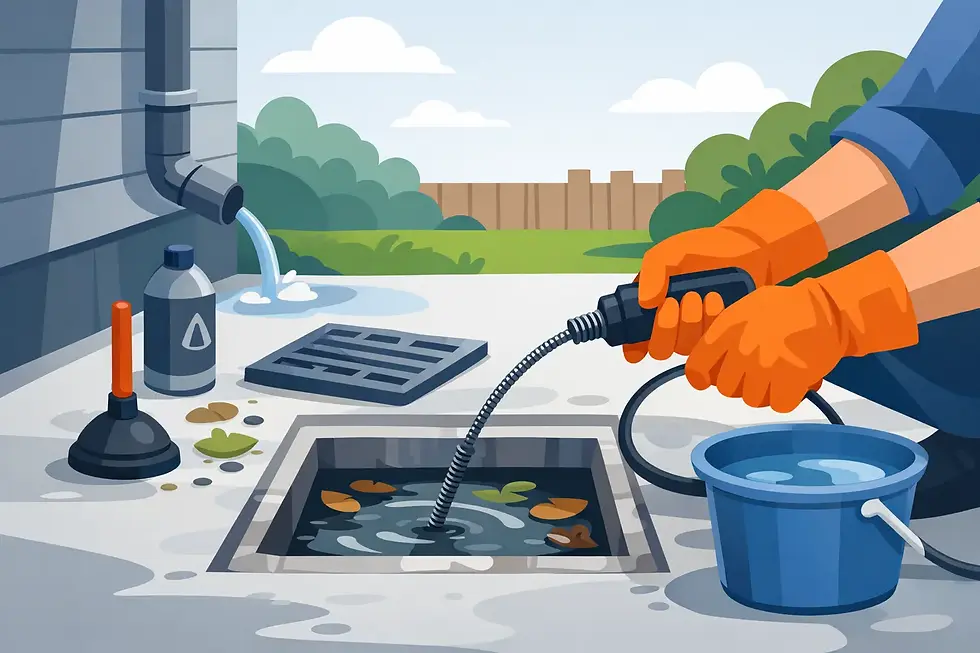
When the blockage is further into the drainage run, drain rods can be effective. They are commonly used on external drains, inspection chambers and longer sections of pipe where a simple plunger will not reach.
The advantage is distance and mechanical force. The risk is misuse. Poor technique can compact a blockage, disconnect joints or damage old pipework. In some cases, particularly with fragile drains or awkward junctions, rods can make the situation worse rather than better.
For that reason, rodding is best treated as a controlled method rather than a general DIY fix. If you are dealing with repeated backing-up, foul odours from multiple points, or a chamber that keeps filling, there may be a structural issue behind the blockage that rods alone will not solve.
5. Drain snakes and mechanical augers for stubborn local blockages
A snake or auger is useful where the blockage sits beyond the trap but is still within reach of handheld equipment. Hair in shower wastes, compacted food debris and localised soft obstructions can often be broken up or pulled back with this method.
It is more precise than a plunger and less blunt than rods, which makes it suitable for certain internal waste pipes. Even so, it has limits. It will not remove heavy grease lining an entire pipe, and it will not address root ingress, scale build-up or a collapsed drain.
There is also a difference between consumer-grade tools and professional mechanical machines. The latter are far more effective, but they need experience to use safely, especially on narrow or delicate pipe runs.
6. High-pressure water jetting for thorough drain cleaning
For more serious blockages, high-pressure water jetting is often the most effective option. It does not just punch a small hole through the blockage. It cleans the pipe wall, removes grease, scale, silt and debris, and helps restore the full bore of the drain.
This is why jetting is widely used on domestic, commercial and construction sites when a blockage needs a more complete solution. It is especially useful where recurring issues suggest the drain is heavily fouled rather than simply blocked at one point.
Among the best drain unblocking methods, jetting stands out because it combines clearance with cleaning. That said, it still depends on the condition of the drain. If the pipe has collapsed or roots have entered through failed joints, even a successful jetting visit may only be a temporary fix unless the underlying defect is repaired.
7. CCTV surveys when the blockage keeps coming back
A blockage that returns after clearing is usually telling you something. It may be wipes building up in a poor section of pipe, grease collecting in a sagging line, root ingress, scale, displaced joints or cracked pipework. In those cases, the right method is not more force. It is proper inspection.
A CCTV drainage survey shows what is happening inside the system so the blockage can be dealt with accurately. For property managers and commercial clients, this matters because repeat call-outs cost time and money. For homeowners, it avoids the frustration of paying for temporary clearance while the real issue remains untouched.
Survey-led work is also important before repairs. If a line needs patching, relining or replacement, identifying the defect first leads to a faster and more cost-effective outcome.
When chemical drain cleaners are not the best option
Many people reach for chemical cleaners first because they are easy to buy and promise a quick fix. Sometimes they will shift minor organic build-up. Often, they do very little against a substantial blockage.
The trade-off is that harsh chemicals can sit in the pipe if water is not draining, which creates a handling risk for anyone working on the blockage afterwards. They can also be unsuitable for some pipe materials and are rarely the best answer for repeated problems. In professional drainage work, chemical products are generally a last resort rather than a first choice.
Knowing when to stop and call drainage engineers
There is a clear line between a manageable blockage and a problem that needs specialist attendance. If sewage is backing up, if several outlets are affected, if outside drains are overflowing, or if the blockage returns after basic clearing attempts, it is time to escalate.
The same applies on commercial premises, managed buildings and active sites, where health and safety, access issues and operational continuity all matter. A fast but incomplete fix is not always the cheapest option if disruption continues.
Experienced drainage engineers bring more than one tool to the job. They can identify the blockage, clear it with the right method, inspect the line if needed, and advise whether the issue is build-up, misuse or pipe failure. That is the difference between simply getting water moving again and solving the drainage problem properly.
At Burch Drainage Ltd, that practical approach matters because every blockage sits in a wider system, and the best result is not just clearance on the day but a drain that performs as it should afterwards.
If your drain is slow, backing up or repeatedly blocking, the safest approach is usually the simplest one - deal with it early, choose the right method for the type of blockage, and do not ignore the signs that point to a deeper fault.


Comments